Background & History

This page sets out the history of Marie Curie Woolton, the circumstances of the closure, and how the Liverpool Hospice Pressure Group came to be formed.
How we got here
Marie Curie Woolton
The Marie Curie Hospice on Speke Road, Woolton, Liverpool (L25 8QA) was for decades a cornerstone of specialist palliative care in Liverpool. It provided inpatient hospice beds, specialist nursing care, bereavement support, counselling, and community services for patients and families across the city.
The property is registered freehold in the name of Marie Curie (Company No. 00507597), with a stated value of £1,500,000 as at February 2025. The Hospice was originally built through a brick campaign, part-funded by local residents.
The land is subject to restrictive covenants whose exact terms have not been fully disclosed. LHPG has raised questions about whether the property's land value played a role in the decision to close the inpatient unit.

Timeline of key events
.png)
Our story
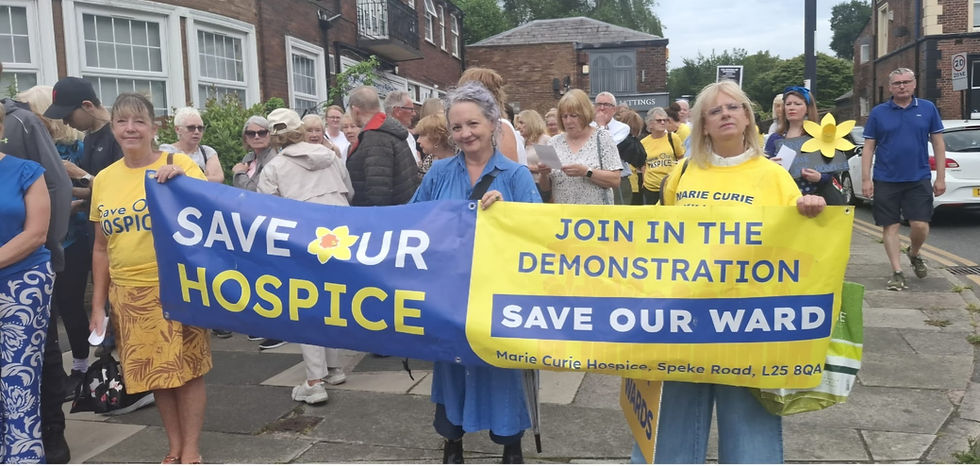
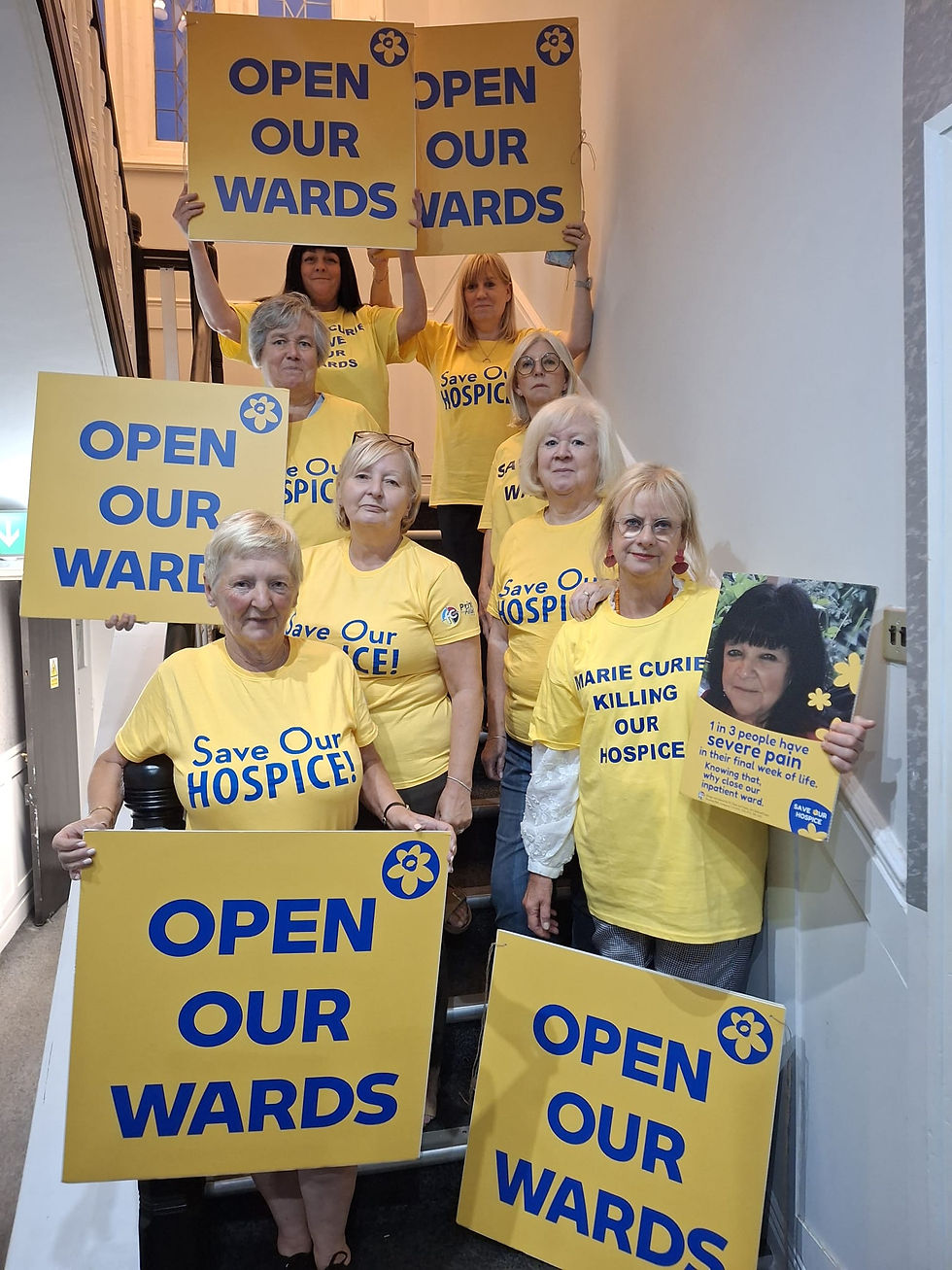
Liverpool Hospice Pressure Group began in February 2025, when local residents came together after discovering that all 26 inpatient beds at the Marie Curie Woolton hospice had been “paused” since July 2024. At the time, the public had been reassured that this was temporary and that the wards would reopen. Instead, for months, Central and South Liverpool had been left with no specialist inpatient hospice beds, and no clear explanation. While North Liverpool still had Woodlands Hospice, the sudden loss of beds elsewhere placed significant pressure on its services. Families in Central and South Liverpool faced long travel distances, reduced choice, and fewer options for dignified, specialist end‑of‑life care close to home. In January 2026, the NHS opened Maple Suite at the Liverpool Heart and Chest Hospital - a 10‑bed unit providing short‑term end‑of‑life care and symptom control. This was introduced strictly as a temporary measure, initially planned to run until October 2026, and later extended until April 2027. Although Maple Suite provided much‑needed relief, it was never intended to replace a hospice, and it highlighted the scale of the gap left by the closure of Woolton’s inpatient beds. The group originally formed as the Liverpool Hospice Action Group, driven by a shared belief that Liverpool deserved transparency, accountability, and equitable access to hospice care.
Early members worked tirelessly to uncover information, raise awareness, and ensure that the disappearance of inpatient beds could not be quietly accepted. In spring 2026, as the group’s purpose sharpened and its advocacy became more focused, members agreed to evolve into the Liverpool Hospice Pressure Group. The new name reflects a clearer mission: applying sustained, evidence‑based pressure on decision‑makers to restore and protect specialist inpatient hospice provision for the whole city. We also acknowledge with respect those who were part of the group at the beginning and who have since stepped back for their own reasons. Their early commitment helped bring this issue into the open and laid the foundations for the work that continues today. Liverpool Hospice Pressure Group now stands as a determined, united voice for the community - pushing for transparency, championing patient dignity, and fighting for a future where every Liverpool resident can access compassionate, specialist end‑of‑life care when they need it most.
What the people of Liverpool are asking
Our public meetings have drawn consistent, urgent questions from residents and professionals. Key themes include:
-
Why was no impact assessment carried out before the decision to close?
-
What is the ICB's actual plan for replacing this provision?
-
Has the land value at Woolton influenced any decision-making?
-
Who is checking how Marie Curie spends the public money it receives?
-
Why are qualified nurses reportedly sitting idle in the hospice building while community patients go without adequate care?
-
What happens to the donations given to Marie Curie in Liverpool if the ward remains closed?
-
Is the ICB's one-year contract with Marie Curie a signal that a longer-term solution is not being planned?
Who is responsible?
The ICB (NHS Cheshire and Merseyside Integrated Care Board) is the fund holder for palliative care in Liverpool. It commissioned Marie Curie to provide inpatient hospice beds at Woolton. It holds statutory responsibility for ensuring public money is spent in accordance with commissioning intentions, and for ensuring Liverpool's population has access to adequate specialist care.
Marie Curie holds responsibility under its own governance, managed by its Board and Trustees, for delivering services in line with the funding and intentions of its commissioning contract.
LHPG believes mistakes were made in the decision-making process, and that potential negligence needs to be examined properly and openly.